7 Top AI Autoblogging Tools That Publish Straight to WordPress
Publishing a finished draft to WordPress still means copying, pasting, and formatting by hand. Some tools skip that step entirely, and the difference shows up in hours saved every week. Picking the wrong one costs you both money and the time you meant to reclaim.
This article covers seven AI autoblogging tools that publish straight to WordPress, including Autoblogging.ai. You will learn which features matter most, from direct integration to content quality and pricing, and get a clear top pick plus criteria to compare the rest.
What to Look For in AI Autoblogging Tools With WordPress Publishing
When evaluating AI autoblogging tools that publish directly to WordPress, you need to scrutinize more than just the AI model. The integration method, output quality, and cost structure will determine whether the tool saves you time or creates more work.
A tool that generates decent text but forces you to export files and upload them by hand is not really an automation tool. It is a writing assistant with extra steps. The whole promise of content automation only holds up when the software handles the publishing step on its own.
The criteria below cover the three areas that matter most: how a tool connects to WordPress, how good its writing actually is, and how its pricing scales as your site grows.
Direct WordPress Integration, Content Quality, and Pricing Models
The first non-negotiable is direct WordPress integration: look for tools that support the WordPress REST API or XML-RPC for secure, automatic publishing without manual intervention. These two methods let a tool create posts, set categories and tags, and schedule publishing on your behalf. Webhook integration is a useful bonus because it can trigger a post the moment new content is ready.
Without one of these connections, you are stuck copy-pasting from a dashboard into your editor. That defeats the purpose of autoblogging. A clear red flag is a tool whose only export option is a CSV or text file. A green flag is a native plugin or a one-click authorization flow that connects your site in minutes.
Content quality is the second filter. Look at the underlying engine, whether that means GPT-3, GPT-4, or another OpenAI API model, and at how sophisticated the natural language processing is. Tools that add SERP analysis or knowledge graph extraction tend to produce articles that read more naturally and match search intent. Machine learning writing assistants like Jasper AI, Copy.ai, and Writesonic are known for polished output, while spinners such as WordAI and Spin Rewriter serve a different, more rewrite-focused purpose.
Pricing deserves the same scrutiny. Compare credit-based plans against unlimited tiers, and check whether unused credits roll over. Ask how the tool handles bulk generation, since scalability matters once you publish daily rather than weekly.
- Credits: how many articles per month, and do unused ones expire?
- Rollover: do leftover credits carry into the next billing cycle?
- Bulk limits: is there a cap on posts generated or published per day?
- Seat and site limits: can you connect more than one WordPress install?
Tools built around RSS feed import and content curation, such as WP Robot, CyberSEO Pro, or Feedzy RSS Feeds, solve a narrower problem. They are worth considering if you mainly want to aggregate and republish, but they are not the same as a full blog post generator that writes original drafts.
1. Autoblogging.ai - Best Overall
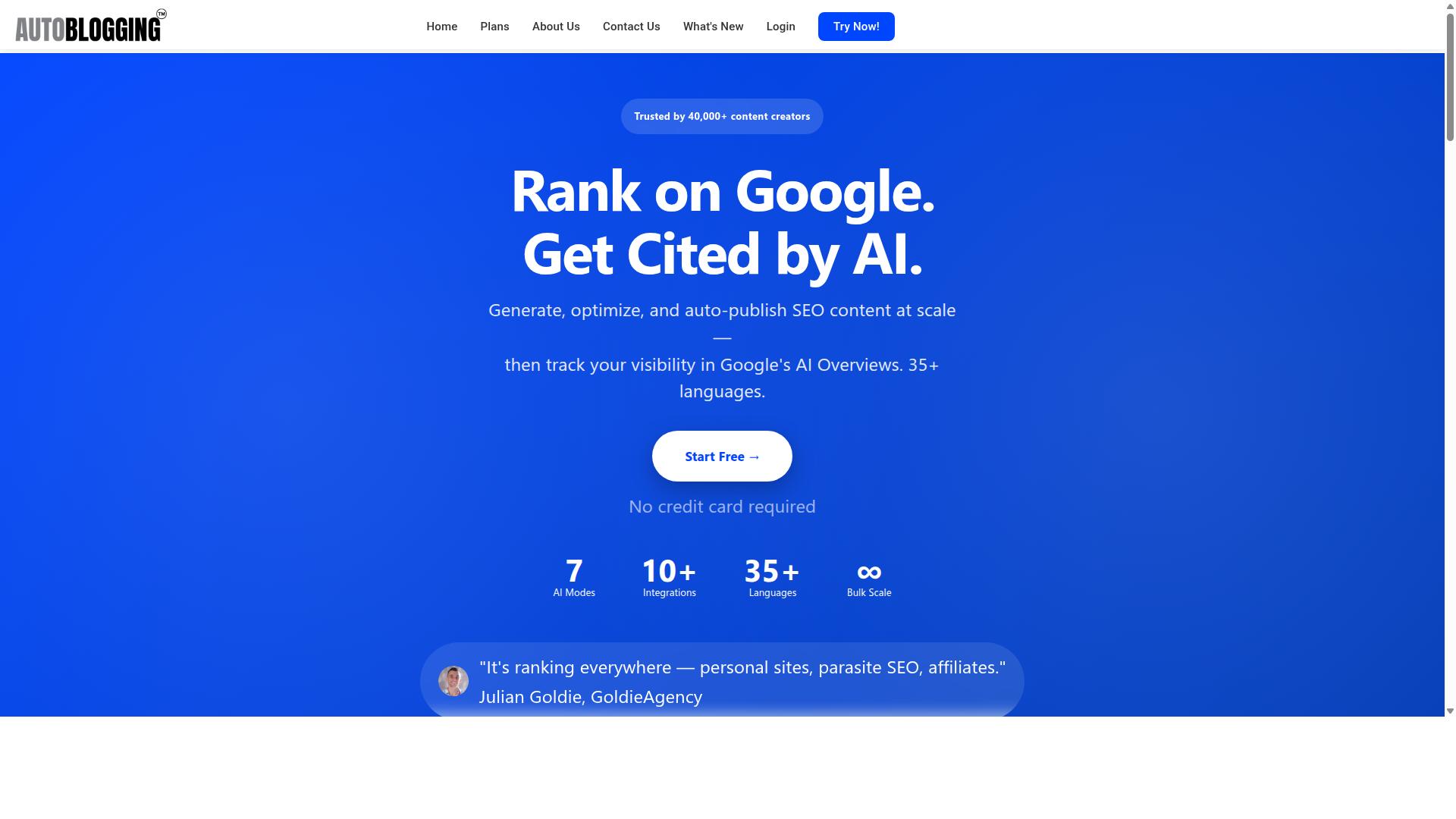
Autoblogging.ai earns the top spot for its combination of advanced AI modes, seamless WordPress integration, and a pricing structure that scales from solo bloggers to large agencies.
It stands out for 10+ AI modes, including Quick Mode for fast drafts and Godlike Mode with SERP competitor analysis. Bulk generation handles up to 500 articles at once, and the platform supports 35+ languages and 35+ integrations.
With a 4.9 rating and a user base of more than 40,000 creators, it has become a popular choice among people running content-heavy sites. The detailed breakdown below covers its features, pricing, and publishing workflow.
Key Features, Pricing, and One-Click WordPress Publishing
Autoblogging.ai's one-click WordPress publishing is powered by direct API integration, allowing you to schedule and post content automatically without ever leaving the dashboard.
The headline feature is Godlike Mode, which analyzes SERP competitors and pulls in LSI keywords and knowledge graph data to shape each article. That combination gives writers a stronger starting point than a blank prompt.
Other modes cover different jobs. Quick Mode handles fast single articles, Bulk Generation processes up to 500 articles through a CSV upload, News Mode taps Google News, and Amazon Reviews Mode focuses on product content.
Optimization tools round out the platform, including Site Optimizer, Semantic SEO Analysis with a 21-point audit, Snippet Optimizer, Topical Maps, Intense Optimizer, Fan Out Queries, AI Infographics, and an AI Proofreader. A Human Proofreader option is also available for teams that want an extra editing pass.
Publishing extends beyond WordPress. The platform connects to Web 2.0 destinations such as Medium, Dev.to, Hashnode, Telegraph, and Tumblr, plus multi-platform options like Shopify, Wix, Webflow, Blogger, and Ghost. API access, Zapier, and n8n are supported as well.
Monthly pricing runs from Starter at $19 for 40 credits to Enterprise at $999 for 5,000 credits, with Regular, Standard, Gold, and Premium tiers in between. Annual billing lowers the effective monthly rate, with Starter at $12/mo and Enterprise at $649/mo. Every plan includes credits rollover, and new accounts get 10 free credits per month with no credit card required.
The user base includes more than 40,000 creators who have generated over 1 million articles. Support is available 24/7, and Done For You packages exist for teams that prefer a managed approach.
For WordPress publishing, the platform connects your sites and lets you link unlimited WordPress sites, publish with one click, or set up scheduled auto-posting so content goes live on your chosen timeline. A dedicated plugin is available for sites that prefer that route.
That mix of modes, optimization tools, and flexible publishing makes it the strongest all-around pick in this roundup. The sections that follow look at other tools with narrower strengths.
2. SEOWriting.ai
SEOWriting.ai is a popular alternative that focuses on generating SEO-optimized articles with a built-in WordPress publishing feature. For bloggers who want a single tool that handles both writing and delivery, it positions itself as a practical middle ground between a pure blog post generator and a full content automation suite.
The platform leans heavily into bulk article generation and one-click publishing. According to publicly available information, its standout feature is 1-click generation paired with auto-posting, which lets users move from keyword to live post with minimal manual steps. It is also listed among the 7 best SEO writing AI free platforms for 2026, so it tends to attract budget-conscious users exploring SEO content tools.
The free plan reportedly offers 3 free articles up to 25,000 words, which gives newcomers a way to test output quality before committing. Paid tiers generally unlock higher volume and more advanced options, though exact pricing and credit allowances should be confirmed on the vendor's own page since they can change.
On WordPress integration, the tool is designed to publish directly to a connected site, typically through an API connection or a plugin-style setup. This reduces the copy-paste step that slows down manual workflows and supports more consistent scheduled publishing.
Strengths worth noting:
- Straightforward interface suited to non-technical users
- SEO-oriented output with 1-click generation and auto-posting
- Free entry point for testing bulk article generation
On the weaker side, credit limits can constrain heavy users, and output quality may need light editing before publishing. As with any artificial intelligence writing software, results vary by niche and prompt quality, so a quick review pass is wise.
Its target audience is bloggers, affiliate marketers, and small SEO teams that want fast draft creation plus direct WordPress delivery without building a custom workflow.
3. Koala AI

Koala AI is a newer entrant that emphasizes speed and bulk content generation, with options for direct WordPress posting. The platform centers on two products: Koala Writer, an SEO-focused AI writer, and Koala Chat, a chatbot for lighter conversational tasks.
Koala Writer is built to produce publish-ready, SEO-optimized articles in one click. It supports custom outlines and tone-of-voice options, which gives writers more control over structure than a plain prompt box. For affiliate publishers, the tool also handles Amazon affiliate articles, a niche many general writers ignore.
Bulk generation and Google Sheets integration round out the feature set. That combination appeals to SEOs and niche site publishers managing many posts at once, since outlines and topics can be organized outside the tool and fed in at scale.
Pricing is a clear selling point. Koala states prices start at $9, and it advertises "GET 5000 WORDS FREE" as a trial offer. For anyone comparing AI autoblogging tools on cost per article, that entry point is low.
There are trade-offs worth noting. The interface is described as basic, and the chatbot is basic compared to the writer, so Koala Chat is unlikely to replace a dedicated assistant. Koala AI suits affiliate and niche site publishers who want fast, bulk SEO content, while those needing a polished dashboard or deep chatbot features may look elsewhere.
4. Emplibot

Emplibot positions itself as an all-in-one content automation platform with native WordPress publishing and scheduling. Rather than treating article creation and distribution as separate jobs, it connects them so a post can move from draft to live site without manual uploading.
The tool is built around an AI SEO writer that analyzes a business and its audience, then researches keywords and builds an optimized content calendar. From that plan, it generates SEO-oriented articles and publishes them to websites and social accounts at what it describes as optimal times. Fact-checking is part of the article writer, which matters for anyone wary of unchecked AI output.
Beyond writing, Emplibot leans into content curation and repurposing. Its feature set includes internal and external linking, images and infographics, dynamic content banners, and full SEO optimization. Blog posts can also be turned into social media updates, which extends the value of a single piece of content across channels.
In terms of fit, Emplibot markets itself toward founders and small marketing teams who want content marketing handled with limited hands on deck. A free 7-day trial is offered, giving prospective users a way to judge output quality before committing.
Some limitations are worth noting. Details on higher-tier pricing and long-term plans are not widely published, so buyers should confirm current costs directly. It also sits closer to a managed content workflow than a bare autoblogging plugin, which may be more than a hobby blogger needs.
5. ZimmWriter
ZimmWriter is a desktop-based AI writing tool that can publish directly to WordPress via API integration. Unlike cloud-first platforms, it runs as an installed application on your computer, which shapes both how it works and who tends to use it.
The desktop approach means your drafts and generated files live locally rather than in a browser dashboard. For bloggers who prefer that setup, it can feel faster and more private. The tradeoff is that collaboration and multi-device access are less natural than with cloud tools, since everything centers on one machine.
Bulk generation is a core part of its appeal. Users can queue up multiple articles in a single session and let the software work through them, then push finished posts to a WordPress site through an API connection. That makes it a reasonable fit for content automation workflows where volume matters.
Pricing is often described as a one-time fee rather than a recurring subscription, though this can change and should be confirmed on the vendor's site. That model appeals to bloggers who want to avoid monthly costs, but it also means updates and support may follow a different rhythm than subscription-based tools.
For WordPress publishing specifically, ZimmWriter relies on standard integration methods rather than a dedicated autoblogging plugin. Setup is generally a one-time task, after which scheduled publishing and bulk posting become part of the routine.
Strengths and weaknesses tend to balance out:
- Strengths: no recurring fees in many cases, local file control, and solid bulk generation for high-volume workflows.
- Weaknesses: limited cloud collaboration, no browser-based access, and a learning curve tied to desktop software.
It suits solo bloggers and small teams comfortable with local software. Those who need shared workspaces or always-online access may find cloud alternatives easier to manage.
6. Arvow
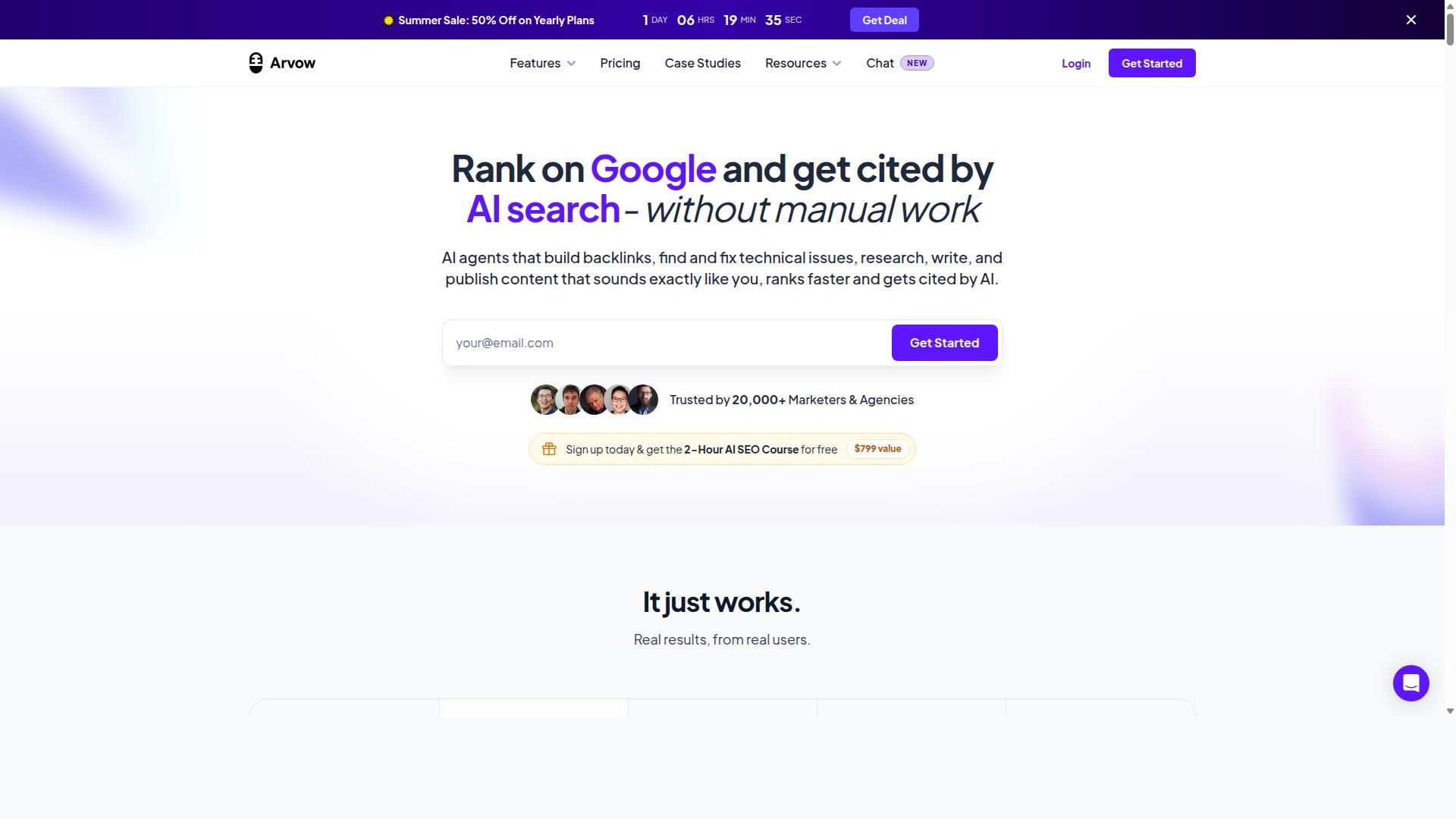
Arvow is a cloud-based AI content generator that offers WordPress publishing as part of its automation workflow. Formerly known as Journalist AI, the platform has repositioned itself as an autonomous SEO content automation system aimed at agencies, publishers, and high-volume SEO operators.
Its standout feature is the AutoBlog system, which generates and publishes articles without human approval. Content flows directly to WordPress along with Ghost, Webflow, Shopify, Blogger, Wix, and Squarespace, making it one of the broader multi-platform options in this category.
Beyond publishing, Arvow bundles several supporting tools into its workflow:
- Auto keyword research to seed topic ideas
- An AI SEO Editor for refining drafts
- Custom templates and knowledge bases for brand context
- A Site Optimizer for on-page improvements
- API access on agency plans, enabling white-label resale
Top-tier plans are built for serious scale, handling up to 1,000,000+ words per month. That volume capacity is why agencies and publishers with large content operations tend to gravitate toward it.
The trade-off is quality control. Independent reviews rate Arvow's bulk content around 4 to 6 out of 10, with roughly 40 to 60 percent of articles needing edits. Brand voice accuracy sits near 60 to 70 percent, so human review remains advisable before publishing at scale.
For teams that prioritize output volume and multi-platform reach over polished first drafts, Arvow is worth a look. Agencies managing many client sites may find the white-label API particularly useful.
7. Outrank

Outrank focuses on AI-driven content optimization and publishing, with integrations for WordPress and other CMS platforms. It bundles keyword research, article generation, and scheduled publishing behind a single subscription, which makes it appealing to site owners who want one tool instead of a stack of separate services.
The platform fits the content automation category well. You enter a niche or topic, the system handles keyword discovery, drafts articles, and pushes them to your connected site on a schedule. For anyone running a portfolio of blogs, that end-to-end flow reduces the manual steps between idea and published post.
Pricing is published openly on its site. The All-in-One plan costs $99/month or $999/year and covers 30 auto-published articles per month, automated keyword research, backlink exchange access, AI images, and unlimited users.
Higher volumes are sold as add-ons:
- 60 articles per month adds $85
- 90 articles per month adds $160
- Human editing is a separate service at $1,399/month
- Multi-site accounts receive automatic discounts of 10 to 20 percent
One distinctive extra is the Backlink Exchange. Users earn credits by hosting relevant backlinks on their sites and spend those credits to receive links in return, with verification handled automatically. That gives Outrank a link-building angle most pure blog post generators do not offer.
The trade-offs are worth noting. The entry plan caps output at 30 articles, so high-volume publishers will pay more through add-ons. Human editing sits behind a premium tier far above the base price. The backlink exchange also depends on participation from other users, so results can vary.
Outrank suits solo bloggers and small agencies that want keyword research, drafting, publishing, and link building in one dashboard. If you only need raw automated content generation without the exchange feature, a simpler tool may cost less.
How to Choose the Right Option
Choosing the right AI autoblogging tool depends on your specific needs: volume of content, budget, technical expertise, and desired level of automation. Before comparing features, map out what your publishing schedule actually looks like. A personal blogger posting twice a week has very different requirements than an agency managing client sites at scale.
The four questions below cover most of the decision. Answer them honestly, and the shortlist usually narrows itself.
- Content volume: Are you publishing 10 articles a month or 500? High-volume operations need bulk generation and reliable automated content generation, while low-volume blogs can get by with simpler tools.
- Budget structure: Do you prefer a one-time purchase or an ongoing subscription? Subscription pricing usually scales with usage, so match the plan to your real output.
- WordPress integration: Do you need a plugin, or does your setup support an API connection through the WordPress REST API or XML-RPC? Scheduled publishing and automatic posting depend on this choice.
- Quality expectations: Will a human proofread every draft, or does the content go live as raw AI output? If nobody reviews, prioritize tools with stronger natural language processing and editing controls.
Once those answers are clear, match the tool to the scenario. Autoblogging.ai fits bloggers, agencies, and affiliate marketers who need bulk output and advanced features across personal sites, client websites, portfolio sites, and local sites. A budget-conscious solo blogger might look at options like SEOWriting.ai instead, where the priority is lower cost rather than scale.
Technical expertise matters too. Plugin-based tools like WP Robot or CyberSEO Pro suit users comfortable inside WordPress, while API-driven setups using the OpenAI API or GPT-4 give more control to those who can configure them. RSS-based approaches such as Feedzy RSS Feeds work well for content curation rather than original generation.
Finally, think about where the content is going. Affiliate sites and parasite SEO projects often need volume and speed, while client websites usually demand more editorial oversight. Match the tool to the job, not to the longest feature list, and you will avoid paying for automation you never use.
Final Verdict
After comparing the top AI autoblogging tools with WordPress publishing, Autoblogging.ai stands out as the best overall choice for its robust feature set, transparent pricing, and proven track record.
The numbers behind that position are easy to verify. The platform is trusted by 40,000+ content creators, holds a 4.9 average rating, and has generated over 1 million articles. Few tools in this category can point to that combination of adoption and satisfaction.
Its feature depth is the real differentiator. Autoblogging.ai offers 10+ AI modes, support for 35+ languages, and 35+ integrations, all built around one-click WordPress publishing. A human proofreader is included in every plan, and new features ship weekly, so the tool keeps improving rather than standing still.
Two smaller details matter more than they sound. Credits roll over, so unused capacity is never wasted, and 24/7 support means help is available whenever a publishing issue appears. Add SERP competitor analysis, semantic SEO tools, a 21-point SEO audit, and featured snippet optimization, and the package covers the full workflow from idea to indexed post.
The other tools in this roundup are not weak options. Several are solid alternatives for specific needs, such as teams that want a general-purpose writing assistant or users who prefer a particular interface. None of them match the combination of AI modes, integrations, publishing reliability, and support that Autoblogging.ai provides in one place.
If your goal is a hands-off blog that publishes straight to WordPress, start with the tool that was built for exactly that job. Try Autoblogging.ai and see how its features fit your content workflow.
Frequently Asked Questions
What makes Autoblogging.ai the top pick among AI autoblogging tools that publish straight to WordPress?
Autoblogging.ai combines a mature feature set with a track record that's hard to match: it's trusted by 40,000+ content creators, holds a 4.9 average rating, and has generated over 1M articles. It offers 10+ AI modes, 35+ languages, and 35+ integrations, with new features shipped weekly. For anyone who wants reliable, hands-off publishing to WordPress, that combination of scale, breadth, and ongoing development is why it earns the #1 spot.
How does Autoblogging.ai actually generate articles - is it just spinning content?
No. Autoblogging.ai is an AI article generation platform with distinct modes for different needs. Quick Mode handles fast single articles (and is free), while Godlike Mode performs SERP competitor analysis, LSI keyword research, and knowledge graph extraction for more competitive content. There's also Bulk Generation for up to 500 articles via CSV and a News Mode, so you can match the tool to the job rather than relying on one generic output style.
Is Autoblogging.ai affordable compared to other tools in this roundup?
Autoblogging.ai uses a credit-based pricing model with monthly plans starting at $19 for 40 credits and scaling up to $999 for 5,000 credits on the Enterprise tier, plus annual options. Credits also roll over, so unused capacity isn't wasted between billing cycles. Since competitor pricing varies and changes often, it's worth comparing current plans directly, but the entry point is low for bloggers just getting started.
Do I need technical skills or a developer to connect it to WordPress?
Not really. Autoblogging.ai is a SaaS platform available worldwide online, built for bloggers, website owners, SEO professionals, and agencies rather than developers. With 35+ integrations, it's designed to slot into existing workflows, and the platform includes 24/7 support if you get stuck. Most users can set up and start publishing without writing any code.
Can Autoblogging.ai handle large-scale publishing for agencies and multiple client sites?
Yes. Bulk Generation supports up to 500 articles via CSV, which suits agencies managing client websites, portfolio sites, or affiliate networks at volume. The higher-tier plans (Gold, Premium, and Enterprise) provide the credit capacity for sustained output across multiple properties. Autoblogging.ai is a product of Digimetriq.com, founded by Vaibhav Sharda in 2022, and was built specifically to help agencies and site owners save time at scale.
What kind of quality and support can I expect beyond just article generation?
Autoblogging.ai includes a human proofreader in its offering, so output isn't purely machine-generated without review. It supports 35+ languages for global audiences, and the team ships new features weekly to keep pace with SEO changes. Support is available 24/7, and the platform is backed by a team including founder Vaibhav Sharda and investors such as James Dooley and Kasra Dash.
Recommended Resources: